
Could AI Monitoring for “Safety” Become a Tool for Worker Surveillance? The Two Faces of AI: “We Must Look at the Employer Behind the Algorithm”
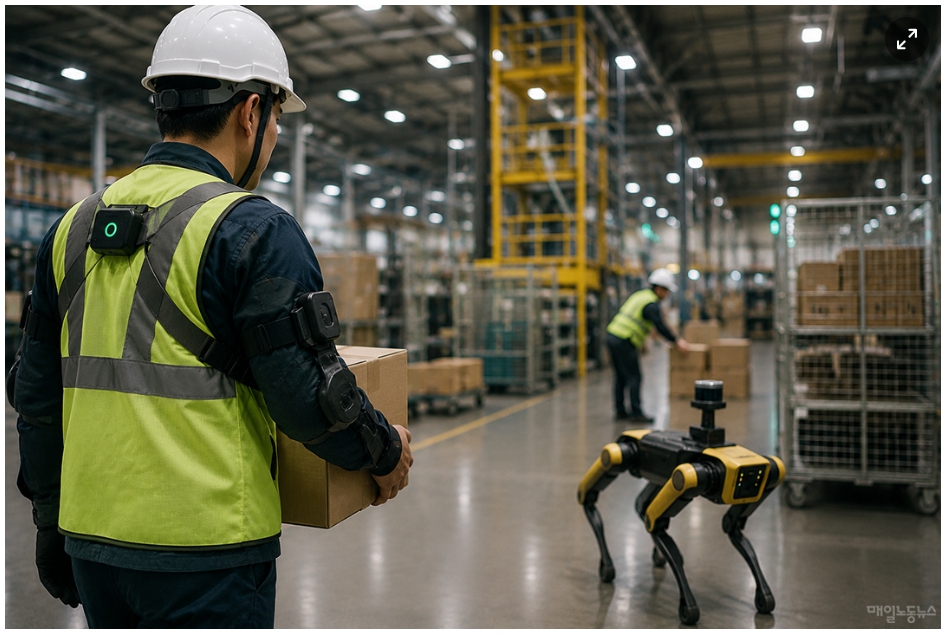
Artificial intelligence (AI) is increasingly being introduced into industrial workplaces as a technology for detecting hazards and preventing accidents. However, concerns are also growing that if information collected about workers’ movements and biometric data for safety purposes is used to assess work speed and performance, AI could become a means of monitoring and controlling workers. Recent cases in which AI has been used to recruit, manage, and even decide to dismiss workers have also raised the question of how much managerial authority should be delegated to AI. On August 17, Maeil Labor News examined the dual nature of AI as both a safety tool and a potential surveillance mechanism.
At Andon Market, a San Francisco store operated by the U.S. AI experimentation company Andon Labs, an AI store manager named Luna is responsible for running the store. Luna posted job advertisements, interviewed applicants, and hired employees. More recently, it decided to dismiss one employee based on the employee’s attendance record and violations of workplace rules. Unlike conventional automation systems that exclude workers from tasks based on predetermined indicators, this case involved a large language model (LLM)-based AI acting as a manager and determining whether an employee should be dismissed.
Experts are paying increasing attention to the possibility that AI introduced into workplaces may function as a tool for surveillance and control. One key issue is whether workers’ location, behavioral, and biometric data collected for occupational safety purposes could subsequently be used for other purposes, such as performance evaluations or disciplinary action.
Yeo-kyung Jang, Executive Director of the Institute for Digital Rights, noted that AI can serve both as a tool for industrial safety and as a means of monitoring and controlling workers. She emphasized that, unlike conventional automation, AI analyzes data relating directly to workers.
The scope of AI use in occupational safety is also expanding. Jang cited examples of logistics-center workers wearing motion-detection sensors while working, as well as workplaces where “robot dogs” patrol and record work areas to check whether workers are wearing appropriate safety equipment. She stated, “An important issue is whether monitoring for occupational safety is simply an extension of conventional surveillance and monitoring, or whether it represents a qualitative change.”
The difference lies in the way information is processed after workers are observed. According to research Jang presented on August 13 at a forum hosted by the Kim Yong-gyun Foundation, titled The Impact of AI on Workplaces and Occupational Safety, conventional CCTV systems required managers to review footage directly. When AI is incorporated, however, large volumes of data collected from smartphones, sensors, and wearable devices, including workers’ locations and movements can be processed and analyzed in real time. Even information such as heart rate and body temperature may become subject to analysis.
Jang explained, “It is possible to collect and process large volumes of data relating to workers or their work, analyze the data in real time through algorithms, and apply the results on an individual basis. This means that the entire range of HR management, including work assignment, evaluation, compensation, and disciplinary action can be based on algorithms.”
She was particularly concerned that information collected for safety purposes might not be used solely for safety. Jang stated, “Data may be collected for safety purposes, but it can easily be applied to other purposes, such as performance management or disciplinary action against workers. The problem is that the workers concerned may not even know that this is happening.”
The possibility that AI could intensify workloads and thereby create new safety risks was also raised. If workers’ work speed and performance are continuously measured and individualized targets are assigned, workers may feel compelled to meet workloads and speeds determined by algorithms even without direct instructions from a manager. Jang explained that such monitoring could “increase work intensity and cause chronic stress and safety risks.”
She argued that “workers must be able to know what information AI collects and how that information is used.” Workers should also be able to request explanations for AI-driven decisions and challenge those decisions. In cases involving serious consequences for workers, such as disciplinary action or dismissal, she emphasized the need for procedures under which a human decision-maker intervenes and reviews the AI’s determination. She also proposed involving workers and labor unions in the introduction and operation of AI systems.
Jang further stressed that an employer cannot avoid responsibility merely because a decision was made by AI. She stated, “Algorithms do not act entirely on their own; the employer determines, to some extent, how they are configured and used. We must not overlook the company behind the algorithm.”
By Dayoung Woo | August 18, 2026, 6:30 a.m.
Source: Maeil Labor News (labortoday.co.kr)
| No | Title | Date | Access | File |
|---|---|---|---|---|
| 308 | Notice A Pioneer of Korean-English Labor Law Content: [Interview] Bongsoo Jung, Certified Labor Attorney at KangNam Labor Law Firm | 25.07.25 | 7693 |

|
| 307 | Notice KangNam Labor Law Firm Personal Advisory Service – When receiving a dismissal notice, instead of a one-time consultation, you can be protected from unfair dismissal through intensive advisory support over the course of one month. | 25.07.02 | 2880 |
|
| 306 | Notice Introduction to Payroll Management Services at KangNam Labor Law Firm: Monthly payroll management, severance pay management, social insurance management, and year-end tax settlement management. | 25.06.18 | 2696 |
|
| 305 | Notice 10 Top Lawyers In Seoul For English-Speaking Foreigners (April 27, 2022): KangNam Labor Law Firm was selected as one of ten best law firms in Seoul by the International Magazine. | 25.03.07 | 6552 |
|
| Could AI Monitoring for “Safety” Become a Tool for Worker Surveillance? The Two Faces of AI: “We Must Look at the Employer Behind the Algorithm” N | 26.08.18 | 73 |
|
|
| 303 | KangNam Labor Law Firm Welcomes Professor Junki Han, HR Expert for Foreign-Invested Companies N | 26.08.13 | 215 | |
| 302 | PRACTICAL KOREAN LABOR LAW IN ENGLISH: 6-Week Case-Based HR Course | September?October 2026 · 4th Term | 26.08.09 | 355 |

|
| 301 | Launch of HR and Organizational Strategy Consulting Services The services will be led and performed by Professor Han Joon-gi, Ph.D. in Business Administration. | 26.08.05 | 555 | |
| 300 | Explaining the Uses of the Multi-Purpose Large Display Screen KangNam Labor Law Firm has recently purchased a large multi-purpose display screen and installed it in its conference room. | 26.07.24 | 838 | |
| 299 | Complete Redesign of the KangNam Labor Law Firm Website | 26.07.23 | 956 | |
| 298 | Today, July 17, is Constitution Day, a national commemorative day in Korea. I would like to examine the relationship between the Constitution and Korean labor law. | 26.07.17 | 1366 | |
| 297 | 2027 Minimum Wage Set at KRW 10,700 per Hour | 26.07.15 | 1476 | |
| 296 | What Will Change from the Second Half of 2026 - Ministry of Employment and Labor | 26.07.15 | 1793 |
|
| 295 | Korea Immigration Office: Visa Management Service | 26.07.10 | 796 | |
| 294 | KangNam Labor Law Firm Applies for a Government-Funded Project for the First Time: The firm submitted an application to participate in the “AI-Based Knowledge Service Platform Development” project. | 26.07.07 | 1164 | |
| 293 | Gangnam Labor Law Firm, A Day Like the Sea | 26.07.05 | 1043 |
|
| 292 | KangNam Labor Law Firm Holds a Workshop July 2, 2026 (Thursday), Beach Area in Gangneung, Gangwon-do | 26.07.03 | 821 |
|
| 291 | Website Revision Project ? Commissioning a Project to Convert the Entire Website into a Responsive Website | 26.07.01 | 757 | |
| 290 | Work on the Third Revised Edition of the Dismissal Manual | 26.06.30 | 773 |
|
| 289 | English Lectures on Labor Law Cases -- 12 Hours July - August 2026, 3rd Term, -- Date: 6-week course, every Thursday evening, 6 sessions July 9, 2026 to August 13, 2026, 7:00 p.m. -- 9:00 p.m. Registration is open until July 9. | 26.06.29 | 809 |
|