
[Analysis of Seven Seoul Regional Labor Relations Commission Decisions] Principal Contractors Responsible for “Industrial Safety” Management in Construction Individual subcontractors alone cannot sufficiently prevent industrial accidents … Seven prin
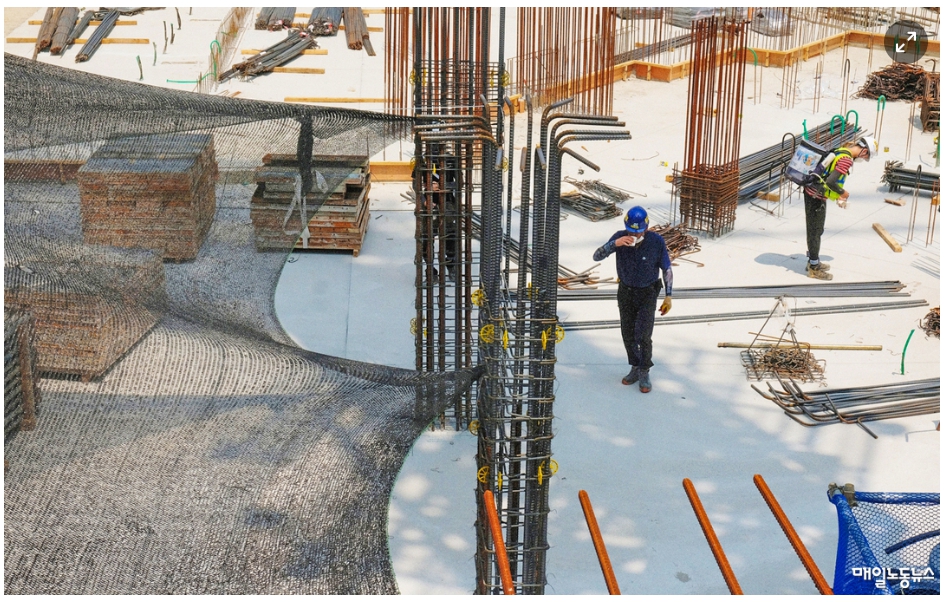
The Seoul Regional Labor Relations Commission has ruled that issues of “industrial safety” at construction sites constitute working conditions that should be addressed through collective bargaining between principal construction contractors and subcontracted workers. The Commission found that the principal contractor’s position of exercising integrated control over an entire construction site involving multiple interconnected work processes itself serves as a basis for recognizing its status as an employer.
According to an analysis by Maeil Labor News of seven decisions obtained by the newspaper on the 19th, the Seoul Regional Labor Relations Commission recognized on the 7th of last month the “employer status of the principal contractor” in cases involving Bando Engineering & Construction, Daewoo E&C, Doosan Engineering & Construction, HLD&I Halla, Ssangyong Engineering & Construction, Hoban Construction, and Hyosung Heavy Industries. The Commission concluded that these companies substantially control and determine working conditions relating to occupational safety and health for subcontracted workers who are members of the Korean Construction Workers’ Union.
Construction Sites Involving Multiple Interconnected Work Processes: Safety Responsibility Lies with the Principal Contractor
The Seoul Regional Labor Relations Commission relied on the particular characteristics of the construction industry, where numerous subcontractors operate together within a single construction site, as a common basis for recognizing the principal contractors’ employer status.
The Commission reasoned that the efforts of individual subcontractors alone have inherent limitations, and that the construction company overseeing the entire construction process must therefore assume responsibility for industrial safety. Because multiple work processes are closely interconnected, a hazard arising in one process can spread to other processes and potentially affect the entire site. Specialized construction companies, which enter into subcontracting agreements with general construction companies, are assigned to construction sites contracted by the principal contractor from the project owner and perform construction work for designated portions of the project.
The principal construction contractors argued that they merely complied with their statutory safety-management obligations under the Occupational Safety and Health Act, the Serious Accidents Punishment Act, and the Construction Technology Promotion Act, and therefore did not determine the working conditions of subcontracted workers.
However, the Seoul Regional Labor Relations Commission held that compliance with statutory obligations does not, in itself, constitute grounds for denying the principal contractor’s employer status.
In the cases involving Bando Engineering & Construction and HLD&I Halla, the Commission explained:
“The reason the Occupational Safety and Health Act imposes safety-measure obligations on the principal contractor is that only the principal contractor is capable of establishing work standards for the entire site, coordinating the work processes of multiple subcontractors, and controlling site facilities. Considering the characteristics of construction sites where large numbers of subcontracted workers work together, as well as the position of principal contractors and subcontractors within multilayered subcontracting structures, their respective roles, and the scope of their responsibilities, the principal contractor is the only entity capable of ensuring industrial safety in a practical and effective manner.”
From Access Control to Approval of Hazardous Work: Construction Companies Make the Decisions
The Seoul Regional Labor Relations Commission also found that construction companies such as Hyosung Heavy Industries, Doosan Engineering & Construction, and Daewoo E&C exercise overall control over construction operations and substantially determine key matters affecting the safety of subcontracted workers, including site access, coordination of work sequences, improvement of working conditions, and approval of hazardous work.
The Commission’s reasoning was that such matters cannot be determined independently by individual subcontractors and can only be decided by the principal contractor that manages the entire construction site.
In the case of Hoban Construction, the Commission held that requiring all construction workers to pass through a facial-recognition system before entering the site went beyond ordinary security management and amounted to control over the personnel permitted to provide labor at the site.
Even though the system was not used to calculate attendance or wages, the Commission found that this did not affect the analysis of the principal contractor’s control over the workplace and facilities because the bargaining agenda raised by the Construction Workers’ Union concerned “industrial safety.”
The Commission also cited as a basis for recognizing Hoban Construction’s employer status the fact that the company itself determined whether to introduce and how to use safety-management equipment such as drones, closed-circuit television (CCTV), and smart safety vests, and used those systems to monitor work and safety conditions at the site in real time.
The Commission viewed these practices as evidence that the principal contractor structurally dominated and controlled working conditions relating to the work environment and safety of subcontracted workers.
In addition, the operation by individual construction companies of their own safety policies and independently developed safety programs was also regarded as supporting recognition of the principal contractors’ employer status.
By Lee Soo-yeon Published: August 20, 2026, 6:30 a.m. su@labortoday.co.kr
Source: Maeil Labor News
| No | Title | Date | Access | File |
|---|---|---|---|---|
| 310 | Notice A Pioneer of Korean-English Labor Law Content: [Interview] Bongsoo Jung, Certified Labor Attorney at KangNam Labor Law Firm | 25.07.25 | 7704 |

|
| 309 | Notice KangNam Labor Law Firm Personal Advisory Service – When receiving a dismissal notice, instead of a one-time consultation, you can be protected from unfair dismissal through intensive advisory support over the course of one month. | 25.07.02 | 2890 |
|
| 308 | Notice Introduction to Payroll Management Services at KangNam Labor Law Firm: Monthly payroll management, severance pay management, social insurance management, and year-end tax settlement management. | 25.06.18 | 2702 |
|
| 307 | Notice 10 Top Lawyers In Seoul For English-Speaking Foreigners (April 27, 2022): KangNam Labor Law Firm was selected as one of ten best law firms in Seoul by the International Magazine. | 25.03.07 | 6565 |
|
| [Analysis of Seven Seoul Regional Labor Relations Commission Decisions] Principal Contractors Responsible for “Industrial Safety” Management in Construction Individual subcontractors alone cannot sufficiently prevent industrial accidents … Seven prin N | 26.08.20 | 20 |
|
|
| 305 | CJ Logistics Agencies Hit by Wave of Unpaid Delivery Commissions KRW 49 Million in Unpaid Commissions Reported in Suwon Following Similar Cases in Namyangju and Ilsan N | 26.08.19 | 91 |
|
| 304 | Could AI Monitoring for “Safety” Become a Tool for Worker Surveillance? The Two Faces of AI: “We Must Look at the Employer Behind the Algorithm” N | 26.08.18 | 192 |
|
| 303 | KangNam Labor Law Firm Welcomes Professor Junki Han, HR Expert for Foreign-Invested Companies N | 26.08.13 | 310 | |
| 302 | PRACTICAL KOREAN LABOR LAW IN ENGLISH: 6-Week Case-Based HR Course | September?October 2026 · 4th Term | 26.08.09 | 439 |

|
| 301 | Launch of HR and Organizational Strategy Consulting Services The services will be led and performed by Professor Han Joon-gi, Ph.D. in Business Administration. | 26.08.05 | 643 | |
| 300 | Explaining the Uses of the Multi-Purpose Large Display Screen KangNam Labor Law Firm has recently purchased a large multi-purpose display screen and installed it in its conference room. | 26.07.24 | 892 | |
| 299 | Complete Redesign of the KangNam Labor Law Firm Website | 26.07.23 | 989 | |
| 298 | Today, July 17, is Constitution Day, a national commemorative day in Korea. I would like to examine the relationship between the Constitution and Korean labor law. | 26.07.17 | 1388 | |
| 297 | 2027 Minimum Wage Set at KRW 10,700 per Hour | 26.07.15 | 1501 | |
| 296 | What Will Change from the Second Half of 2026 - Ministry of Employment and Labor | 26.07.15 | 1814 |
|
| 295 | Korea Immigration Office: Visa Management Service | 26.07.10 | 810 | |
| 294 | KangNam Labor Law Firm Applies for a Government-Funded Project for the First Time: The firm submitted an application to participate in the “AI-Based Knowledge Service Platform Development” project. | 26.07.07 | 1179 | |
| 293 | Gangnam Labor Law Firm, A Day Like the Sea | 26.07.05 | 1053 |
|
| 292 | KangNam Labor Law Firm Holds a Workshop July 2, 2026 (Thursday), Beach Area in Gangneung, Gangwon-do | 26.07.03 | 831 |
|
| 291 | Website Revision Project ? Commissioning a Project to Convert the Entire Website into a Responsive Website | 26.07.01 | 768 |