
Failure to Reduce Wage Inequality: Wage Gap Between Regular and Non-Regular Workers Reaches Record High August Supplementary Survey by Employment Type Shows Nearly Twofold Wage Difference … Number and Proportion of Non-Regular Workers Also Reach Rec
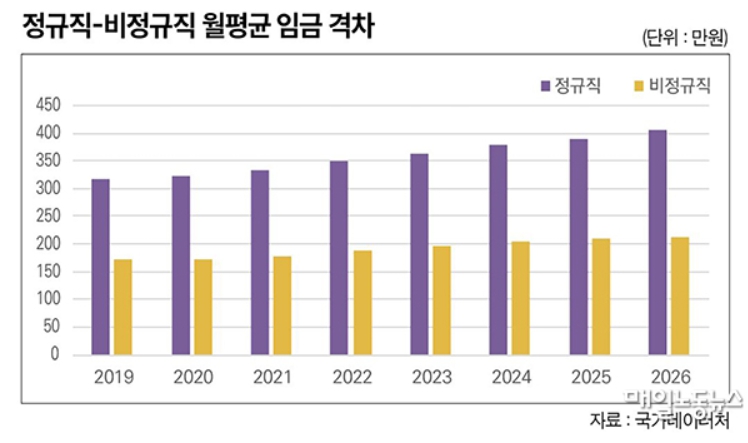
The wage gap between regular and non-regular workers has widened to its highest level on record. Both the number of non-regular workers and their proportion of all wage and salary workers have also reached their highest levels since relevant statistics were first compiled. While the government attributes these developments to increases in part-time and older workers, critics argue that they reflect insufficient policy efforts to reduce labor market polarization, including inadequate minimum wage increases.
Non-Regular Workers Earn Just 52.1% of Regular Workers' Wages
“Real Minimum Wage Growth Has Been Negative Since 2000”
According to the August 2026 Supplementary Survey of the Economically Active Population by Employment Type, released by the National Data Agency on October 21, the average monthly wage over the preceding three months was KRW 4,052,000 for regular workers and KRW 2,112,000 for non-regular workers. Compared with the same month of the previous year, wages increased by KRW 156,000 (4.0%) for regular workers and KRW 24,000 (1.1%) for non-regular workers. Non-regular workers earned just 52.1% of the wages received by regular workers, marking the widest gap since statistical records began in 2003. Over the past five years, the ratio of non-regular workers' wages to regular workers' wages in August stood at 53% in 2021, increased to 54% in 2022, 2023, and 2024, and declined to 53.6% in 2025.
Disparities in social insurance coverage also widened. The National Pension enrollment rate among regular workers reached 88.6%, an increase of 0.7 percentage points from a year earlier. In contrast, the enrollment rate among non-regular workers fell by 0.6 percentage points to 36.5%. National Health Insurance coverage stood at 95.7% for regular workers and 53.0% for non-regular workers, representing an increase of 0.7 percentage points and a decrease of 0.2 percentage points, respectively. Employment Insurance coverage reached 93.0% for regular workers and 54.0% for non-regular workers, increasing by 1.2 percentage points and 0.3 percentage points, respectively.
The National Data Agency identified the growing number of part-time and older workers as major factors contributing to the widening wage gap.
Kim Rak-hyun, Director of the Employment Statistics Division, explained: "The increase in part-time workers, who generally work fewer hours and consequently receive lower monthly wages, appears to have had a significant impact. When part-time workers are excluded, the wage growth rate for non-regular workers rises from 1.1% to 2.0%."
As of August 2026, the number of part-time workers stood at 4.382 million, including overlapping employment categories, an increase of 153,000 (3.6%) from the same month of the previous year.
Kim further explained:
"The increasing proportion of employed workers aged 60 and older has also contributed to this trend. In the health and social welfare services sector, which employs a relatively large proportion of older workers, the number of non-regular workers increased by approximately 112,000."
However, some labor experts argue that persistently modest minimum wage increases have failed to narrow wage disparities.
Kim Yoo-sun, Chairman of the Korea Labour and Society Institute, stated:
"When minimum wage increases are accumulated from 2000 to the present, they have failed to keep pace with inflation, meaning that the cumulative real minimum wage increase has been negative."
He continued:
"Although the minimum wage was raised substantially for two years under the Moon Jae-in administration, strong opposition from the business community subsequently led to a more restrained approach. The increases under the Yoon Suk-yeol administration were also notably low."
Kim added:
"The current government has likewise failed to implement sufficient measures to address wage inequality and labor market polarization, including meaningful minimum wage increases. More proactive policy efforts are needed."
Number of Non-Regular Workers Reaches Record High of 8.671 Million
The number of non-regular workers also increased. Of the total 22.526 million wage and salary workers, 13.855 million were regular workers, an increase of 10,000 from the previous year. Meanwhile, the number of non-regular workers rose by 103,000 to 8.671 million. Non-regular workers accounted for 38.5% of all wage and salary workers, up 0.3 percentage points from a year earlier. Both the number and proportion of non-regular workers reached their highest levels since the relevant statistics were first compiled in 2003.
By employment type, after eliminating overlaps between categories, fixed-term and other temporary-contract workers constituted the largest group, numbering 5.398 million, or 62.2% of all non-regular workers. Other categories included 734,000 dispatched and outsourced workers, 566,000 workers in special types of employment, 385,000 daily workers, and 101,000 home-based workers.
Regarding the increase in both the number and proportion of non-regular workers, Kim Rak-hyun explained:
"As employment among people aged 60 and older has increased, a relatively larger share of these workers has entered non-regular employment rather than regular employment. The growing share of employment in the health and social welfare services sector has also contributed to this trend."
By Kim Hak-tae
Published: October 22, 2026, 6:30 a.m. Email: tae@labortoday.co.kr
Source: Labor Today (Maeil Labor News) https://www.labortoday.co.kr
| No | Title | Date | Access | File |
|---|---|---|---|---|
| 365 | Notice A Pioneer of Korean-English Labor Law Content: [Interview] Bongsoo Jung, Certified Labor Attorney at KangNam Labor Law Firm | 25.07.25 | 8460 |

|
| 364 | Notice 10 Top Lawyers In Seoul For English-Speaking Foreigners (April 27, 2022): KangNam Labor Law Firm was selected as one of ten best law firms in Seoul by the International Magazine. | 25.03.07 | 6941 |
|
| 363 | Notice · Event: Kangnam Labor Law Firm 2026 Fall HR Forum · Theme: Labor Risk Outlook and Strategic HR Directions for Businesses in the AI Era N | 26.10.25 | 38 |
|
| 362 | Notice Kangnam Labor Law Firm and B&H Tax Accounting Firm Sign MOU for Strategic Business Cooperation On October 13, 2026 N | 26.10.20 | 101 | |
| 361 | Notice Regarding Legislation to Extend the Mandatory Retirement Age: A Conversation between Dr. Jun-Ki Han and Labor Attorney Bongsoo Jung | 26.09.03 | 324 | |
| Failure to Reduce Wage Inequality: Wage Gap Between Regular and Non-Regular Workers Reaches Record High August Supplementary Survey by Employment Type Shows Nearly Twofold Wage Difference … Number and Proportion of Non-Regular Workers Also Reach Rec N | 26.10.26 | 34 |
|
|
| 359 | ·Event: Kangnam Labor Law Firm 2026 Fall HR Forum · Theme: Labor Risk Outlook and Strategic HR Directions for Businesses in the AI Era N | 26.10.25 | 76 |
|
| 358 | Human Resource Management ? Compensation Policy: N | 26.10.24 | 93 | |
| 357 | Fundamental Principles of Human Resource Management: The Right Person in the Right Job and Effective Recruitment Procedures N | 26.10.21 | 307 | |
| 356 | Kangnam Labor Law Firm and B&H Tax Accounting Firm Sign MOU for Strategic Business Cooperation On October 13, 2026, N | 26.10.20 | 282 | |
| 355 | How Should Reference Checks Be Conducted in Human Resource Management? N | 26.10.20 | 290 | |
| 354 | DongSung Chemical Unilaterally Implements Voluntary Retirement Program Ahead of Overseas Production Transfer N | 26.10.20 | 327 |
|
| 353 | [Roundtable on the Amended Trade Union Act ? Manufacturing Subcontractor Unions] “We Followed the Labor Ministry’s Guidelines, Only to Be Blocked by the Court” What Are the Concerns of Subcontractor Unions at Donghee Auto, Hankook Tire, Hanwha Ocean N | 26.10.19 | 407 |
|
| 352 | [Exclusive] Complaints Over Illegal Dispatch and Disguised Subcontracting Surge 2.7-Fold in Three Years 292 complaints filed in 2025 and 174 in the first half of 2026, while the prosecution rate falls to just 6.9%. | 26.10.13 | 572 |
|
| 351 | Back on the Ground After 194 Days: First Step Toward Excluding Taxi Drivers from the Deemed Working Hours System | 26.10.12 | 675 |
|
| 350 | Salary Negotiations from the Employer’s Perspective (SMEs and Startups): How to Address Differences Between Job Applicants’ Salary Expectations and the Company’s Salary Budget. | 26.10.10 | 603 | |
| 349 | Measures to Address Employee Disagreement with Performance Evaluation Results in a Performance-Based Compensation System: | 26.10.10 | 546 | |
| 348 | KOSAF to Bargain with Call Center Workers Following National Labor Relations Commission Ruling Principal Employer Status Recognized for “Protection of Emotional Labor Workers” … First Meeting with the General Service Workers’ Union Scheduled for Oct | 26.10.07 | 602 |
|
| 347 | Reward for Reporting Fraudulent Wage Payment Claims Increased to KRW 200 Million Amendment to the Enforcement Decree of the Wage Claim Guarantee Act Approved … Labor Minister: “We Will Enhance the Sustainability of the Substitute Payment System” | 26.10.07 | 513 |
|
| 346 | Performance evaluation is at the core of human resource management: Management by Objectives (MBO) vs. Objectives and Key Results (OKR) | 26.10.04 | 622 |