|
|
| Home > Books > Wage Manual |
|
| |
|
|
|
|
|
|
|
|
|
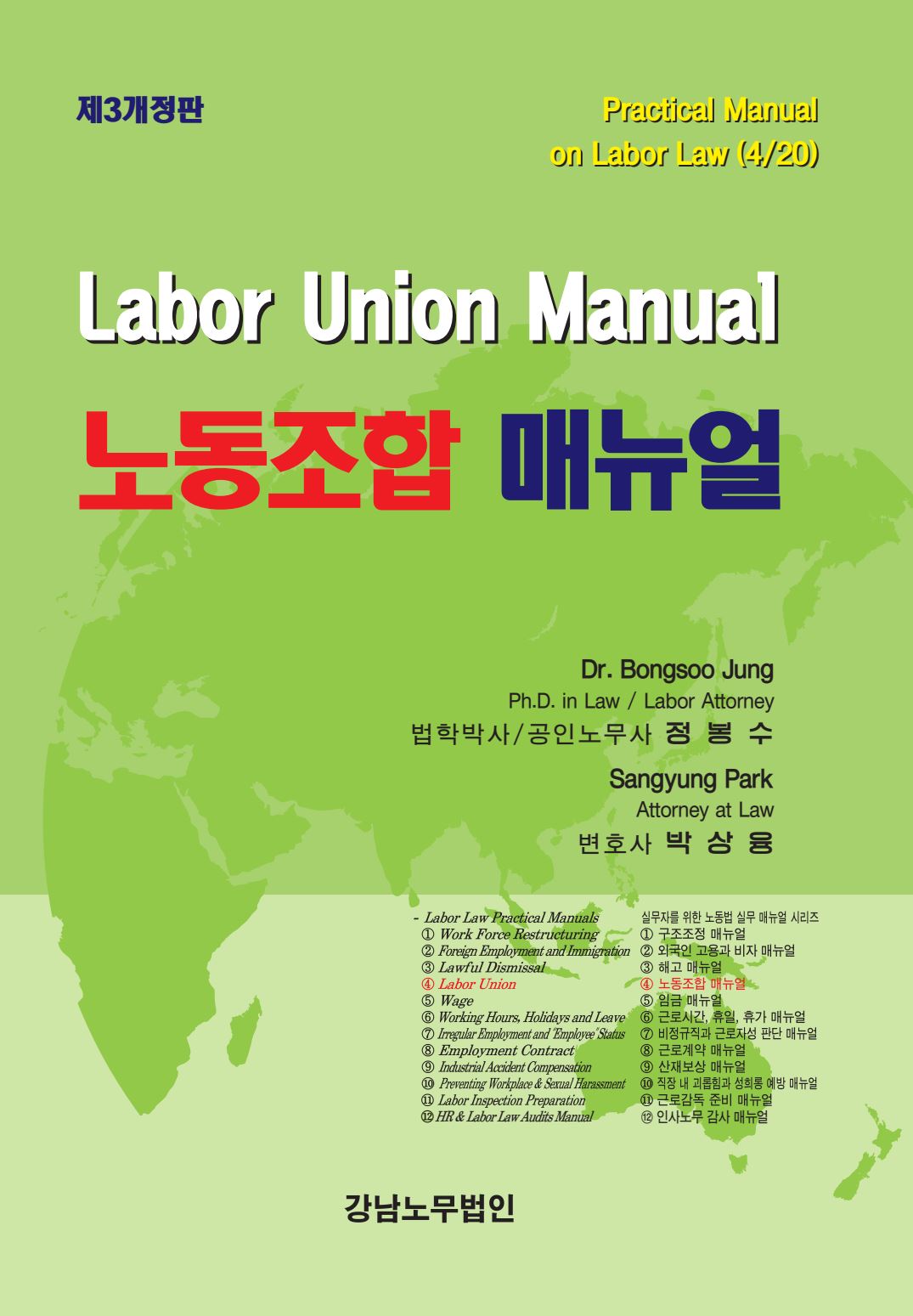
Labor law is constructed around two basic legal structures: the Labor Standards Act, based on Article 32 of the Constitution of the Republic of Korea, and establishes minimum working conditions to protect human dignity; and the Trade Union and Labor Relations Adjustment Act, based on Article 33 of the Constitution, and designed to guarantee the three labor rights towards improving working conditions. Article 33(1) of the Constitution states, "To enhance working conditions, workers shall have the right to independent association, collective bargaining and collective action." Towards better realization of these three basic labor rights for workers, the Labor Union Act was enacted. Contrary to the intent of this law, many companies and workers perceive unions as negative organizations, but I remain convinced that the only way to protect workers' rights and improve working conditions is through union activities.
This manual makes use of the practical experience and practical data I have gained on how to establish and operate a labor union. The practical examples it provides on collective bargaining and collective action illustrate the process of establishing mutually beneficial relations between labor and management through a variety of cases arising out of collective agreements during lengthy negotiations between labor and management.
In particular, this manual includes a detailed explanation of the amended Labor Union Act (commonly referred to as the
‘Yellow Envelope Act’), which will come into effect on March 10, 2026. The protection of non-regular workers has inherent limitations when addressed solely through individual labor standards legislation. As a final institutional safeguard to eliminate discrimination against non-regular workers, the Labor Union Act can be used to improve the working conditions of subcontracted and outsourced workers.
|
|
|
|
|
 |
Buy Books |
 |
|
|
|
 |
|
|
| |
|
|
|
 |
[Address] A-1501 406, Teheran-ro, Gangnam-gu, Seoul 06192 Korea (Daechi-Dong, Champs Elysees Center)
Tel : 02-539-0098, Fax : 02-539-4167, E-mail : bongsoo@k-labor.com
Copyright© 2012 ~ 2026 K-Labor. All rights reserved. [Privacy Policy] |
 |
|
|









 Connect to the app