 |
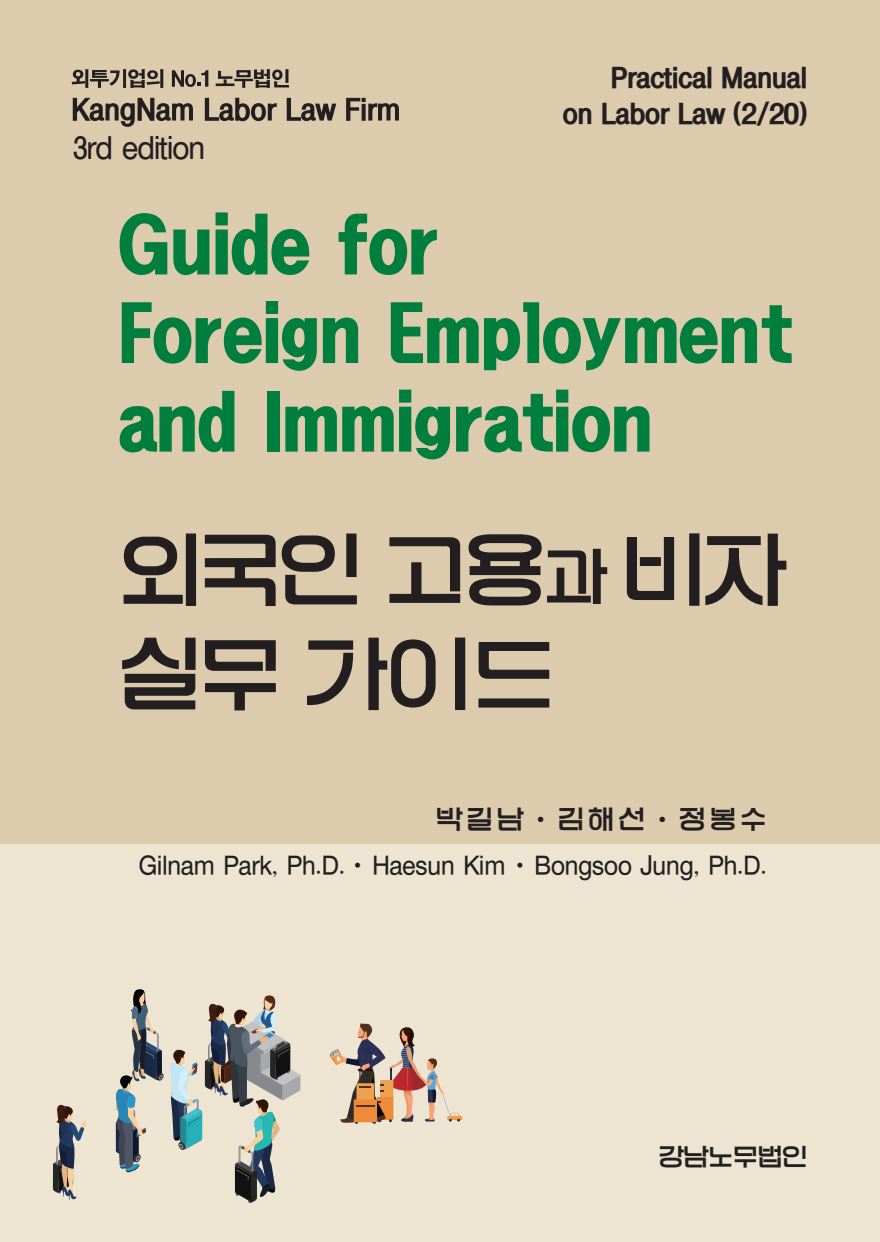
Human Rights of Foreign Workers
I. Introduction
As of December 2023, there were 2.5 million foreigners staying in Korea for more than 3 months. This comprises 5% of all Koreans. If this increasing trend continues, long-term-staying foreigners will amount to 3 million people in 5 years, which will be 6% of the total population.
The reason for the increase in foreigners is because the Korean market requires more cheap foreign workers and foreign-trained professionals. This rapid increase in foreign workers has caused various social problems, such as illegal foreign workers, an increase in crimes by foreigners, rising unemployment for domestic Koreans, etc. However, as there are more economic benefits through the use of foreign workers than there are disadvantages caused by such problems, the number of foreign workers will continue to increase. Since a considerable number of foreign workers live side-by-side with domestic Koreans, it is necessary to seriously consider their human rights in terms of the various labor laws.
Foreign workers have moved to Korea for economic reasons, and even though they are not directly subject to the rights of citizens as guaranteed by the Constitution of the Republic of Korea, they are granted the right to pursue happiness and human rights. Hereunder I would like to review the international standards of foreign workers’ human rights, and then determine their labor law applications as shown in related decisions of the Constitutional Court and the rulings of the Supreme Court.
II. International Standards for the Human Rights of Foreign Workers
Article 6 of the Constitution stipulates, “Treaties duly concluded and promulgated under the Constitution and generally recognized rules of international law shall have the same force and effect of law as domestic laws of the Republic of Korea. Status of aliens shall be guaranteed in accordance with international laws and treaties.” Korea joined the United Nations (UN) on September 17, 1991, and on the following day joined the International Labor Organization (ILO). Details regarding human rights are substantialized through declarations (constitutions) and agreements (covenants) of international organizations, and Korea, as a member country, is obligated to observe rules as regulated by these organizations.
The UN adopted the ‘Universal Declaration of Human Rights’ in the General Assembly in 1948, and established common standards of human rights that all people and all nations should adhere to, regardless of differences in politics, economy, culture and religion. The UN later adopted two covenants on human rights in 1966, which are the ‘International Covenant on Economic, Social and Cultural Rights (A Covenant or Social Rights Covenant)’ and the ‘International Covenant on Civil and Political Rights (B Covenant or Human Rights Covenant). Additionally, the UN confirmed the international standards of human rights for second-class citizens such as women, infants, ethnic minorities, foreign workers, etc. The ILO includes the ‘ILO Constitution’ and the ‘Declaration Concerning the Aims and Purposes of the ILO (Declaration of Philadelphia).’
These declarations and Constitutions are ”generally recognized rules of international law” as regulated by Article 6 of the Constitution of Korea, which promote the general standards of human rights that all nations should satisfy. However, it is necessary for it to be ratified in the National Assembly and substantialized in order to become valid under present law. Korea ratified 6 human rights covenants: ①the Social Rights Covenant and ②Universal Declaration of Human Rights (1990); ③the International Convention on the Elimination of All Forms of Racial Discrimination (1978); ④the Convention to Eliminate of All Forms of Discrimination against Women (1981); ⑤the Convention on the Rights of the Child (1990); and ⑥the Convention against Torture and Other Cruel, Inhuman or Degrading Treatment or Punishment (1987). In addition, Korean ratified ⑦the Covenant Relating to the Status of Refugees (1992), and in the ILO covenants, ⑧the Covenant Concerning Discrimination in respect of Employment and Occupation (111st) (1998) and ⑨the Covenant Concerning Equality of Treatment for National and Foreign Workers as regards Workmen’s Compensation for Accidents (19th) (2001). However, Korea has not yet ratified some rules of international law regarding human rights such as the UN’s ‘International Convention on the Protection of the Rights of All Migrant Workers and the Members of Their Families’, enacted in and effective in 1990); the ILO’s ‘Migration for Employment Convention (97th), which became effective in 1952; the ‘Convention Concerning Migrations in Abusive Conditions and the Promotion of Equality of Opportunity and Treatment of Migrant Workers (97th), which became effective in 1978).
III. The Constitutional Court’s Decisions and the Supreme Court’s Rulings Regarding Foreign Workers
1. The Constitutional Court’s Decisions
(1) Legal status of foreign workers and the restrictions on their freedom of choice in the workplace
Foreign workers filed a constitutional complaint that Article 25 of the Act on Foreign Workers’ Employment, etc., violates freedom of choice in the workplace, as a change of workplace is permitted only three times in a three-year period.
As for the validity of this claim, the Constitutional Court admitted that foreign workers are entitled to the right to pursue happiness and the right to take legal action, as are all men, despite not being Korean citizens. However, the restrictions under the Employee Permit System are not a violation of their freedom to choose a workplace.
The Constitutional Court stipulated: “The freedom to choose a workplace under the freedom of occupation is not directly related to the rights of a citizen, but rather the rights of men, because the freedom to choose a workplace is closely related to human dignity and worth and the right to purse happiness. Therefore, it is justifiable that foreign workers should have the freedom to choose a workplace even though permission is limited. As long as the applicants received the work permit legitimately, entered Korea and maintained regular lives according to the justifiably permitted status, these applicants are entitled to basic human rights regarding the freedom to choose a workplace…..This article was designed to restrict foreign workers from changing their workplace frequently, in order to protect the opportunity for Korean employees to keep their employment, promote the effective management of foreign workers, and also to make sure of providing manpower, which will contribute to the balanced development of the national economy. Furthermore, this article guarantees the freedom of foreign workers to choose a workplace up to three times within three years in case of necessity for changing workplaces, and additionally gives them the opportunity to change their workplace for unavoidable circumstances stipulated in the presidential decree. Therefore, this article does not give unreasonable disadvantages that exceed the lawmakers’ discretion.”
(2) The industrial trainee system violates the Constitution
The Constitutional Court concluded that the industrial trainee system is unconstitutional because it violates equal rights, as trainees were excluded from the application of some parts of the Labor Standards Act due to their trainee status, even though trainees provide labor service in place of earning wages. This decision abolished the industrial trainee system.
The Constitutional Court stipulated, “Even though industrial trainees with a trainee’s contract provided labor service under the employer’s direction and supervision, they then received wages. In the actual relations, as only foreign industrial trainees were excluded from the application of major labor laws without justifiable reason, we found it unreasonable….. The fact that industrial trainees are excluded from some parts of the Labor Standards Act, unlike ordinary employees, is arbitrary discrimination. Under Article 5 of the Labor Standards Act and Article 4 of the ‘International Covenant on Economic, Social and Cultural Rights’, a stipulated law is required in order to restrict the ‘right to have equivalent working conditions for an equal value of work’. As this discriminating provision is regulated in the Administrative Rule, this is also a violation of the principle of statutory reservation.”
2. The Supreme Court’s Rulings
(1) Legal status of illegal foreign workers
The Employee Welfare Corporation rejected an application for industrial accident compensation as follows: “Foreign worker A from Thailand, who came to Korea with a trainee working visa and had stayed beyond the permitted period, was seriously injured while working. Foreign worker A applied for compensation for medical treatment to the Employee Welfare Corporation, but the Corporation rejected the application, explaining that foreign worker A is an illegal migrant worker with illegal employment, and that the employment contract the employer made with him was illegal as well. Therefore, foreign worker A was not applicable under the Labor Standards Act, or IAC Insurance.” However, the Supreme Court ruled that even though illegal employment is clearly an act to be punished, the work already provided is the actual performance done, which is subject to the protection of the labor laws. Accordingly, illegal foreign workers may apply to IAC Insurance. This ruling was the first case ever made for an illegal foreign worker’s work-related injury to be accepted as an occupational accident under the IAC Insurance Act.
The Supreme Court made the following judgment: “Article 15 (1) of the former Immigration Act regulated the activities that foreigners could conduct while staying in Korea, the scope of status of stay and the period of stay, and subparagraph (2) regulated restrictions on the employment of foreigners. The purpose of this law was not just to crack down on illegal foreign workers, but to protect the domestic employment market from incoming illegal foreign workers, and to control foreign workers effectively so as to maintain the working conditions of domestic workers.”
However, the Supreme Court admitted the illegal migrant worker’s injury as an occupational accident with the following ruling: “The Immigration Act is to prohibit the actual practice of using illegal foreign workers, not denying the validity of work already provided or employee status already determined by the employment relations.”
(2) Three labor rights of illegal foreign workers
It has generally been considered unacceptable for illegal foreign workers to be applicable to three labor rights according to current labor law. However, recently there has been a very important judicial ruling that illegal foreign workers are not only accepted as to employee status in individual employment relations, but also re-confirmed as to employee status in collective labor relations. The illegal foreign workers living in Seoul and Kyunggi province submitted a report of the establishment of a labor union to the Seoul Regional Labor Office on May 3, 2005, but their application was rejected due to their illegal worker status. Even in the courts there have been disputes on whether a labor union of illegal foreign workers can be admitted or not, but the Supreme Court admitted the establishment of a labor union consisting of illegal foreign workers on June 25, 2015.
The Supreme Court ruled as follows: “An employee in the Labor Union Act refers to a person who provides work under supervisory relations with another person and earns wages in return for that. This is not limited to a person engaged in employment with a particular employer, but also applies to a person who is unemployed and who is looking for a job. Also, anyone who is entitled to the protection of three rights shall belong to this category. The Immigration Act prohibits the actual practice of using illegal foreign workers, but does not deny the right of work already provided or an employee status already determined by the employment relations. Accordingly, if a person provides work under supervisory relations with another person and earns wages in return for that, that person is an employee under the Labor Union Act, and as long as the person is admitted as an employee under the Labor Union Act, regardless of whether the employee is an illegal foreigner or not, or whether the employee was employed or not, such person has employee status under the Labor Union Act.”
IV. Conclusion
In the course of globalization, many advanced countries have had a lot of social issues due to an increasing number of immigrants. However, they have also taken advantage of these cheap foreign workers by supplementing insufficient manpower in their countries while also protecting their domestic labor market, and in this process they have used an immigration system that properly utilizes foreign workers under restricted control to maximize their national profits. However, Korea has not yet introduced a well-organized immigration system in terms of using foreign workers, and therefore needs more improvement. While protecting the human rights of foreign workers and controlling immigration, a mutually complementary relationship between foreign workers and domestic workers will be continuously required. Furthermore, through studying the successes and failures of advanced countries regarding foreign workers, we need to prepare a secure, long-term based management system for foreign workers.
|









 Connect to the app